
Third-Down Tendency Scouting for High School Football Coaches
How to turn opponent film into a practical third-down game plan
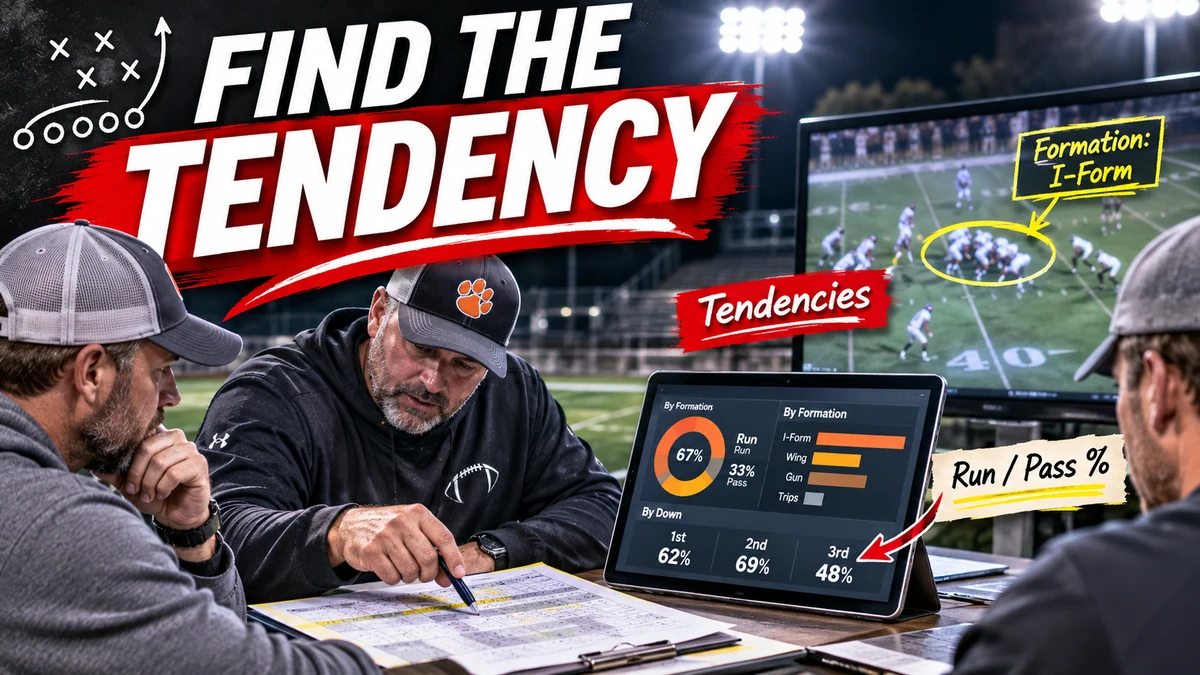
Third down is one of the best places to begin an opponent scouting report. The offense has a clear objective, the defense knows the distance to gain, and coordinators often lean on calls they trust. But a report that says an opponent “passes 70 percent of the time on third down” may not help your defensive coordinator make a single call. Third-and-one and third-and-nine are different situations, and a team protecting a late lead may behave differently from one chasing two scores.
A useful third-down scouting report answers four questions: What situations are we likely to face? What does the opponent prefer in those situations? What evidence supports that conclusion? What will we practice in response? This guide walks through a repeatable process that works for a high school staff charting plays manually, whether the staff has a few games of film or a larger season sample.
1. Start with the questions your staff needs answered
Before opening film, decide which decisions the scouting report should support. Your defensive coordinator might need a third-and-short run alert, a third-and-medium coverage plan, and a third-and-long pressure answer. Position coaches may need protection clues, route combinations, or quarterback scramble tendencies. Define those needs first so the film study does not turn into an endless list of statistics.
Choose a consistent distance grouping. One practical starting point is short (1–2 yards), medium (3–6), long (7–10), and extra-long (11 or more). These are working categories, not universal football rules; adjust them to match your team's terminology. Keep the exact yards-to-gain in your raw data so you can later distinguish third-and-three from third-and-six if the opponent's calls change within the bucket.
2. Chart each snap consistently
For every third-down play in the available film, record the same core fields. Consistency makes it possible to compare games and prevents one coach's “quick pass” from being another coach's “screen.” If a field cannot be determined from the camera angle, mark it unknown instead of guessing.
A practical third-down charting checklist
- Situation: game, quarter, score margin, clock context, down, exact distance, yard line, and hash.
- Offensive presentation: personnel if identifiable, formation, backfield alignment, splits, shifts, and motion.
- Play family: designed run, dropback pass, play-action, screen, quarterback run, or other clearly defined category.
- Concept and direction: run scheme or pass concept when the film supports it; note the target side and any formation strength.
- Defensive picture: front, apparent coverage shell, pressure, and late rotation when visible.
- Outcome: yards gained, first down or touchdown, incompletion, sack, turnover, or penalty, with notes on what affected the result.
- Film reference: a clip or timestamp that lets the staff verify the tendency without searching the entire game again.
Keep called play separate from observed result. A quarterback scramble on a called pass should not automatically become a designed quarterback run in the tendency totals. Likewise, a sack may be a pass attempt for scouting purposes even though it is not recorded as a completed or incomplete pass. Decide your definitions once and apply them throughout the report.
3. Build a situational tendency table
Start with counts, not percentages. Imagine a fictional opponent with 24 charted third-down snaps across several games. The numbers below are illustrative examples, not actual team data.
| Distance | Snaps | Designed runs | Called passes | What to investigate |
|---|---|---|---|---|
| 1–2 yards | 6 | 4 | 2 | Heavy sets, sneak, play-action |
| 3–6 yards | 9 | 3 | 6 | Quick game, motion, option routes |
| 7–10 yards | 7 | 1 | 6 | Protection, sticks concepts, screens |
| 11+ yards | 2 | 0 | 2 | Checkdowns, draws, field position |
The fictional team called passes on six of nine medium-distance snaps: 6 ÷ 9, or about 67 percent. That observation is more useful than a single overall third-down percentage, but nine plays remain a small sample. Add a note about which games those plays came from and whether the team faced similar defensive looks. Two extra-long snaps should not be treated as a stable tendency at all.
Separate conversion rate from play preference
A play family can be frequent without being successful. Track play selection and conversion separately. Conversion rate is the number of plays that gained a first down or scored divided by eligible third-down attempts, according to your charting rules. Penalties that award a first down, accepted penalties that replay the down, and end-of-half situations deserve consistent handling. Put the numerator and denominator beside every rate so the staff can see the evidence.
4. Look for formation, motion, and protection clues
After sorting by distance, compare the opponent's offensive presentation. Does an empty set on third-and-medium lead to a quick throw? Does the offense move its best receiver into the slot? Does a condensed formation create a rub route or crossing concept? Do they keep a back in protection against pressure, or release all five eligible receivers?
Watch for repeated relationships, not merely repeated plays. A staff might discover that motion toward trips precedes a quick perimeter throw, or that a tight end aligned off the ball is frequently involved in pass protection. These are hypotheses to test against multiple clips. Find at least one counterexample: a good opponent can use the same presentation to run a different concept.
Quarterback behavior matters too. Chart whether the quarterback throws on rhythm, extends plays, favors a particular side, or runs when the first read is covered. Distinguish a designed quarterback run from a scramble. A defensive call that handles the initial routes but loses contain may still be the wrong practical answer.
5. Account for field position and game situation
Not every third down has the same risk profile. Near midfield, an offense may call third down with a potential fourth-down attempt in mind. In its own territory, it may favor field position. In the red zone, route spacing and available vertical space change. In the final minutes, the clock and score can override normal preferences.
When you have enough plays, add filters for field zone, score margin, and quarter. When you do not, use short qualitative notes such as “only observed while trailing late” or “two examples came in four-down territory.” Do not manufacture precision from sparse film. The point is to help the coordinator recognize when a tendency may no longer apply.
6. Pair every useful tendency with representative film
A tendency table tells coaches where to look; film explains why the play worked. For each major situation, save two representative clips and, when possible, one exception. Review the pre-snap alignment, motion, defensive reaction, protection, quarterback progression, and point of attack. Ask whether the offensive concept succeeded because of its design, an individual matchup, a missed tackle, or a defensive bust.
Use a simple three-part annotation for each clip: trigger (what players should recognize), threat (what the offense is trying to create), and response (what the defense should communicate or execute). This turns a collection of video into a teachable plan.
7. Translate the report into a defensive call sheet
Do not hand players a ten-page data dump. Condense the findings into a one-page call sheet organized by distance. For each row, include the likely formation or motion, the offensive concept to alert, the defensive response, and a film reference. Add the sample count in small type so the staff knows which alerts are well supported.
| Situation | Opponent alert | Defensive preparation | Evidence |
|---|---|---|---|
| 3rd & 1–2 | Interior run / play-action | Fit discipline; do not abandon eligible receivers | Review six short-yardage clips |
| 3rd & 3–6 | Quick-game and motion indicators | Practice communication and leverage | Review nine medium clips |
| 3rd & 7–10 | Sticks routes / pressure answers | Rush-lane integrity and coverage landmarks | Review seven long clips |
This table is a sample format using fictional data. The actual defensive calls must come from your coordinator and your players' capabilities. A coverage adjustment that looks clever on paper is not useful if the unit cannot communicate it before the snap.
8. Build the tendencies into a weekly practice plan
Choose the three or four third-down situations most likely to affect the game. Rehearse them with realistic distance markers, formations, shifts, motion, and tempo. A simple progression can keep the installation focused:
- Staff review: Agree on the most credible opponent tendencies and the defensive responses before practice.
- Walkthrough: Show the offense's formation and motion clues; require players to make the correct checks aloud.
- Team period: Run representative third-down calls at the actual distance to gain, not an arbitrary yard line.
- Changeup period: Use the same formation with a different concept to test whether defenders are reading keys rather than guessing.
- Situational finish: Mix short, medium, and long distances with clock and field-position context.
Make the scout-team cards reflect the tendencies without becoming predictable. If players know every third-and-five rep is a quick slant, the drill stops testing recognition. Include the opponent's counterpunch and your own contingency call.
9. Use charting and film together in iQSports
iQSports is designed to help football staffs organize manually charted plays and review game information. Coaches can enter plays, examine tendencies and situational analytics, work with scouting information, and use associated video to revisit the evidence behind a report. For third-down preparation, the value is a consistent workflow: chart the plays, filter to the situation, inspect the clips, and turn the findings into coaching decisions.
It is important to distinguish organized analysis from automatic interpretation. A coach still needs to identify the play, judge the defensive look, evaluate the quality of the sample, and decide how the team should respond. The software supports that process; it does not replace film study or automatically guarantee the right call.
10. Review the predictions after Friday night
After the game, compare the opponent's actual third-down choices with your report. Did the expected formations appear? Did the offense change its plan against your front or coverage? Which alerts helped your players communicate, and which were noise? Chart your own defensive outcomes as well: stops, conversions allowed, penalties, explosive plays, and missed assignments.
Keep the lessons for next week. If the opponent broke a tendency, determine whether it was a deliberate adjustment, a different game situation, or simply normal variation in a small sample. A good scouting process gets more useful when the staff reviews its assumptions instead of treating every prediction as fact.
Third-down scouting checklist: the one-page takeaway
- Define distance buckets and use consistent play labels.
- Chart exact distance, formation, motion, play family, result, and film reference.
- Show counts alongside percentages; flag small samples.
- Compare formation and motion clues within each distance group.
- Separate called plays from scrambles, sacks, and unusual penalties.
- Save representative clips plus a counterexample for major tendencies.
- Translate findings into a short defensive call sheet and practice situations.
- Review what happened after the game and refine the process.
Third-down scouting works best when it produces fewer surprises on game night. The goal is not to predict every snap. It is to give your players clear keys, give your coaches evidence for their decisions, and make each practice repetition more intentional.
Turn opponent film into a better game plan
Explore how iQSports supports play charting, scouting, tendencies, and film review for high school football coaching staffs.
Explore iQSports